Showing posts with label Social Advocacy. Show all posts

Friday, January 3, 2020

Reaching out to the Scholars- An initiative from WBADMIP to generate aspirations among the young talents towards Sustainable Development!


             West Bengal Accelerated Development of Minor Irrigation Project(WBADMIP) is soon to complete its 7th year. Since its inception in March 2012, Project has been able to create a roadmap in multiplying farmer's income in a sustainable manner. However, the journey associated with the project's accomplishments has never been easy. It is surrounded with lots of complexities that needs smart decisions for their timely redressal. Besides posing challenges from time to time, these complexities also has given opportunities for the project officials to understand the dynamics of development activities at the grassroots and come up with working model from the lessons learnt. 
             With the objective to acquaint the scholars with the projects narratives on the lessons learnt as well as to inculcate the essence of becoming a development practitioner, project launched its "Internship Program" in the year 2018 where four international and three domestic students successfully completed their internship. Out of the four international students, 3 were from Harvard University, US and one was from RMIT, Australia whereas, among the domestic students, two were from IIT and one from Delhi University. There are always room for improvements in any development project. The tacit and explicit information captured by the interns from their field visit is helping the project officials to refine the project interventions more farmer specific. The learning will also help the students to gain insight to the real world challenges and solutions through active exploration.
             In Dec 2019, Project also facilitated a study tour comprising of 47 BSc Horticulture Science students from Dr. Y.S Parmar University of Horticulture & Forestry, Solan, Himachal Pradesh.
           
Interns Joao from Harvard University, US and Somveer from IIT Kgp with Bankura DPMU team, June 2018

                             
Rhia from RMIT, Australia in Canning Block, 24 Paraganas South, Aug 2018


Interns Sujoy and Sophie from Harvard University, US in Darjeeling District, Aug 2019


Intern Aryaman from Delhi University visiting Birbhum, July 2018


BSc students from Dr. Y S Parmar UHF, Himachal Pradesh in 24 Paraganas South, Dec 2019


Thursday, January 2, 2020

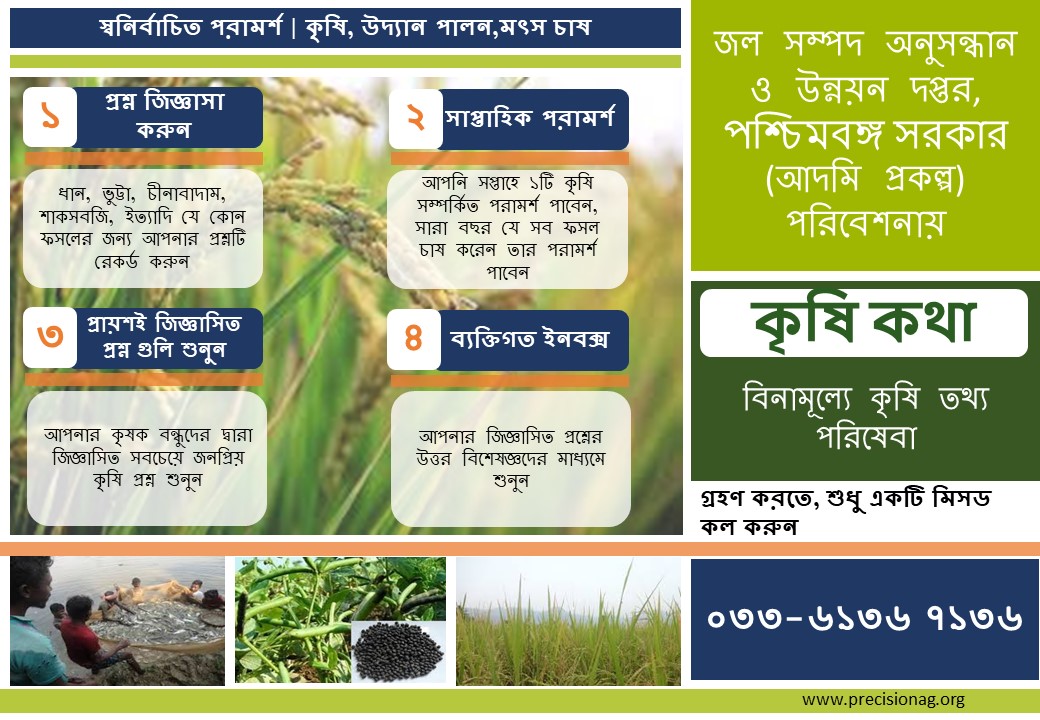
Empowering Farmers through ICT- Introducing Mobile Based Farm Advisory Service, "Krishi Katha" in the Project areas.

                    Information and Communication Technology (ICT) in modern day agriculture plays a crucial role in expanding horizons in its development. ICT is all about empowering the farming community in the decision making process while adopting best approaches to improve their food security and livelihood.
       Till few years back, it was beyond imagination for many to consider how mobile phones can play powerful role in revolutionising the agricultural extension services. Even though the government have their own mechanism to carry out the agriculture extension service , but in a state like Bengal with high population density it needs a huge manpower to cover every corner of the state. Mass Media such as TV, Radio, Press has been the most commonly used medium since decades to carry out  the extension services but there are limitations considering their one way communication approach.
     Mobile phone is becoming one important tool of communication, according to a survey conducted in 2015, the number of mobile phone users in India will reach over 800 million by the end of 2019. In the farming sector too, mobile phones are playing crucial role in empowering farmers to get better access to the market information. Mobile phone ownership and its application in agricultural extension service is getting attention among the policymakers. As a result, various Govt agencies and development organisations has initiated mobile based farm advisory services to reach at the grassroots..
        Mobile based ICT tools can play effective role during various farming cycle. During pre sowing stage, information on weather, soil moisture and agri inputs such as seeds, pesticides, fertilisers etc. will increase the adaptability of crops to the local climatic condition whereas information on best practices and pest management will enhance the quality as well as quantity of the farm produce. Post harvest information on storage practices, available markets and commodity prices will increase the value of the farm produce. From Bengal perspective, mobile based farm advisory services becomes even more significant due to the fact that climate change impact is becoming prominent in the farmlands. It is predicted that the weather variability as a result of climate change in the state will increase, in such situation farm advisory through mobile phones will expand  the extension service to larger areas in short time.
       With a similar objective to gear up the extension service in minimum time, West Bengal Accelerated Development of Minor Irrigation Project(WBADMIP) launched  its mobile based advisory service "Krishi Katha" on pilot basis initially in 14 districts covering 10,000 farmers. It is an integrated system with the combination of Interactive Voice Response System (IVRS), Web and mobile phone technology to disseminate farm specific advisory service as per user's convenience with time and mode. The advisory service have two interfaces, a mobile interface at the front end for its registered farmers and a web interface at the back end for a team of agriculture experts. Besides disseminating information through voice and sms, the farmers can also call at the service's Toll Free number and record their query. The queries are responded within 12-48 hours. The advisory service is developed and operated by US based Non Profit Organisation, Precision Agriculture For Development (PAD) with Project's funding. Initially implemented for 6 months, the Service already reached the target of 10,000 farmers and looking at the good response from the farmers, project is further exploring the possibility of expanding the service to  more districts in the coming days.


Monday, March 18, 2019

The essence of World Water Day

Photo: World Water Day celebration in Uttar Dinajpur

                                     
                International World Water Day is annually celebrated since 1993 to create awareness on the sustainable management of fresh water resources. It is a day to celebrate the importance of water and to express solidarity to the collective action on drawing a global consensus for water conservation. Hence, World Water Day is an opportunity to learn about water related issues, feel motivated to share among others and take pledge to work on making the difference.

Key facts:

  • Out of total water available in the planet, 97.5 % is saline and is unfit for drinking or irrigation purposes.  Only 1 % is readily available while rest remains in the form of glacier.
  • By 2025, two third population of the world could be under water stress by 2025.
  • In India, there has been a decrease in the per capita water availability from 5178 min 1951 to 1544 min 2011( Central Water Commission, 2017)   
  • In West Bengal, as the agricultural activities and industrial development taking momentum, the water deficit percentage also increasing tremendously from 38 % in 2000 to 48 % in 2011. In the current trend, it is predicted that the deficit will reach 58 % by 2025. ( Rudra, 2007)
  Initiatives from the Project:
         
          The agriculture sector puts enormous pressure on the country's water resources especially ground water aquifers.Although there are many technological advances but these are often beyond the capacity of the financially starved small and marginal farmers. WBADMIP during its inception was more focused towards  ground water based schemes as such only 30 % of the schemes undertaken initially belongs to surface schemes. But soon the project shifted its policy towards more surface water schemes ( around 70 % Surface water, 30 % Ground water) with the main objectives of,,

  • reducing pressure on ground water aquifers 
  • Increasing surface water storage capacity
  • addressing issue of ground water salinity prevalent in the coastal districts.
Besides shift in policy in the irrigation system development, the project is also implementing water smart extension services among the water users majority of which belongs to small and marginal category ( about 80%). As a part of the service, farmers are trained on various aspects of participatory irrigation management to increase the water productivity as well as reduce the water wastage. Knowledge are being disseminated through well tailored capacity building program on water budgeting, crop planning, conservation agriculture, efficient O&M etc

WWD Celebration in Bardhaman
However, with increase in water as well as farm productivity it is also necessary for the farmers to realise that water is a scarce commodity and without conservation measures it wouldn't sustain for long. It is even more crucial for state like Bengal where 96 % of the farmers belongs to small and marginal land holding category, a deficit rainfall season can push them towards heavy loss. In this regard, the project officials picked up World Water Day as the ideal platform to spread the awareness on these water issues and build a collective action at grassroots level to systematise the effort into coherent body of knowledge on importance of water conservation. As a part of this initiative, for the first time  World Water Day  was commemorated in the project areas  on 22nd March last year with the participation of large number of Water User Associations spread around the state.

Nadia
In Bardhaman district, around 3000 Water User Association members from several block organised the event collectively marked by mass rallies with slogans on water conservation,art competitions, interactive sessions etc. In Southern district of Hooghly, the event metamorphosed into 2 days affair. The first day was organised centrally by Khatul water User Association at Aghorkamini Prakash Chandra College with participation of representatives from several water user associations, teaching community, students etc.In the second day, the WUAs observed locally. In Nadia, the event was organised centrally in karimpur block with the participation of 25 Water User Associations. Besides the WUA members,  the event was also participated by officials from local administration as well as line departments, teaching and student community, local progressive farmers etc. Various competitions on water conservation was organised and the winners were awarded with packet of Bio-pesticides. 
Bankura

In Western districts, tribal women were seen taking active participation in mass rallies carrying posters and raising slogans on water conservation. In the other districts also World Water Day was organised with similar enthusiasm and magnitude.